

Branding vs. Marketing: What’s the Difference and Why Your Business Needs Both


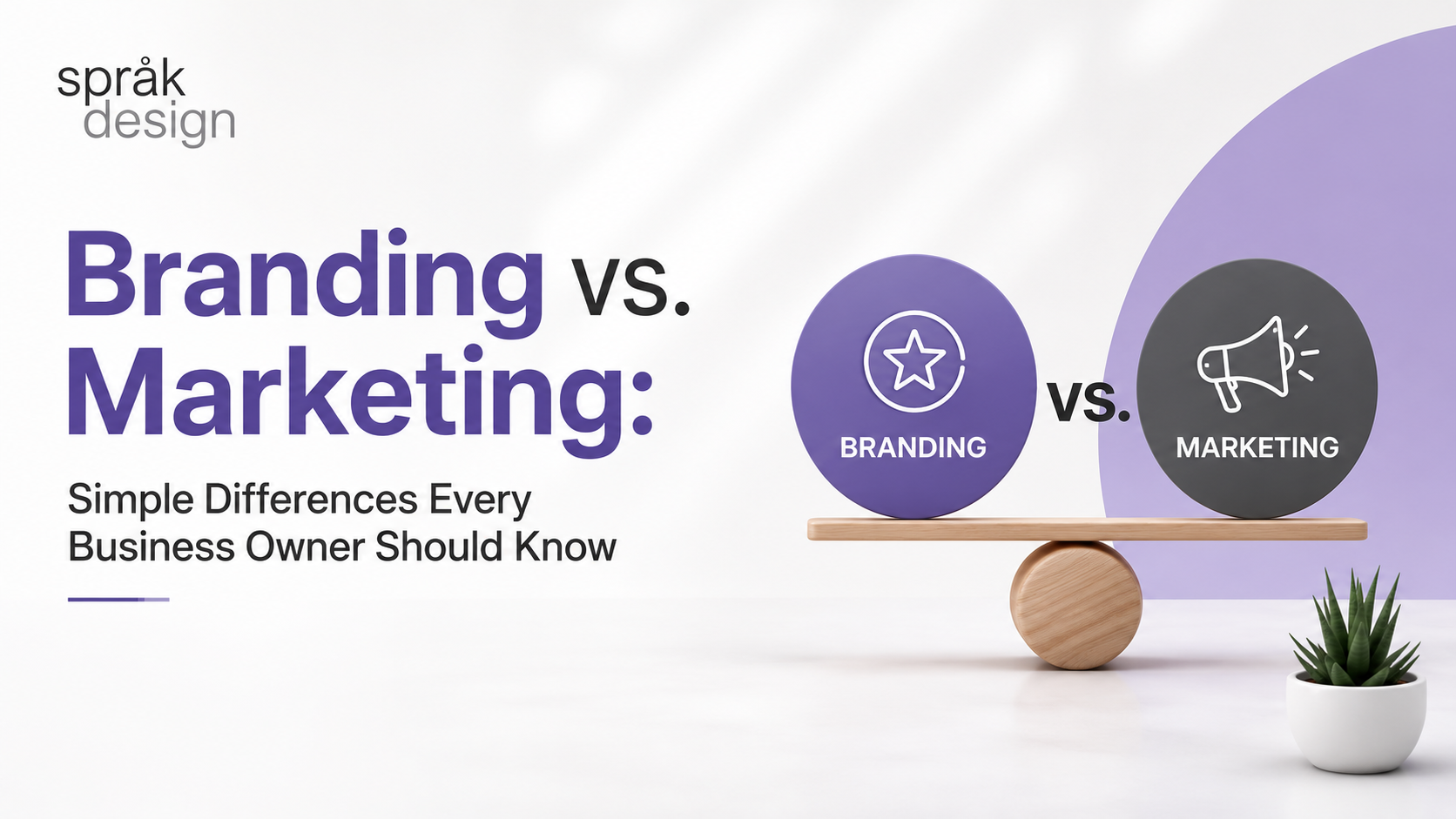
Branding is who you are — your identity, values, and the emotional trust people feel toward your business. Marketing is how you tell people about it — the campaigns, channels, and tactics that drive awareness and sales. Branding builds long-term recognition; marketing drives short-term action. In 2026, businesses that treat these as one strategy, not two separate departments, grow faster and retain customers longer.
If you’ve ever wondered whether you need a logo designer or a branding services partner, the honest answer is you probably need both, working from the same playbook. This guide breaks down exactly where branding ends and marketing begins, how the two connect, and how to build a strategy that uses them together.
Quick Answer: Branding vs Marketing at a Glance
| Branding | Marketing | |
|---|---|---|
| Definition | The identity, personality, and perception of your business | The activities used to promote and sell your products/services |
| Timeframe | Long-term, foundational | Short to medium-term, campaign-based |
| Goal | Build trust, recognition, and loyalty | Generate leads, traffic, and sales |
| Examples | Logo design, brand voice, messaging, values | Social media ads, SEO, email campaigns, PR |
| Changes Often? | Rarely (evolves slowly) | Frequently (adapts to trends and data) |
| Measured By | Brand recall, sentiment, loyalty | Clicks, conversions, ROI, CAC |
Think of branding as the foundation of a house and marketing as the rooms you build and rearrange on top of it. Without a strong foundation, even the best-decorated rooms won’t hold up.
What Is Branding?
Branding is the strategic process of shaping how your business is perceived—everything from your logo design and color palette to your tone of voice, values, and the experience customers have at every touchpoint.
Branding answers questions like:
- What do we stand for?
- How do we want to be remembered?
- What makes us different from competitors?
- What does our audience feel when they interact with us?
Core Elements of Branding
- Visual identity – logo design, typography, color system, imagery style
- Brand strategy – positioning, mission, vision, and value proposition
- Brand voice – the tone and language used across all communication
- Brand experience – how consistent and trustworthy the brand feels across touchpoints
- Digital branding – how the brand shows up on websites, apps, and social platforms
According to the American Marketing Association’s definition of a brand, a brand is a name, term, design, or symbol that identifies one seller’s offering as distinct from others—but in practice, a brand becomes valuable only once that distinctiveness earns real recognition and trust. For a deeper look at branding types, elements, and examples, see our full guide: What Is Branding? Definition, Types & Examples.
A strong brand doesn’t just look good — it creates recognition and emotional trust that compounds over time. This is why companies like Apple and Nike are recognized instantly, even without their name visible: the branding is the recognition.
Real-world example: When olive oil brand Graza launched, it didn’t lead with a discount code — it led with a distinctive squeeze-bottle design, a bold green identity, and a confident, casual tone that made it instantly recognizable on a shelf full of glass bottles. Similarly, canned-fish brand Fishwife built such a strong visual identity that fans began recreating its packaging art on nails, tote bags, and phone cases — free marketing generated entirely by branding strength. Neither brand won on price. They won because people recognized and trusted the identity before ever tasting the product.
What Is Marketing?
Marketing is the set of activities used to promote a brand’s products or services, generate demand, and convert audiences into customers. Where branding shapes perception, marketing drives action. The American Marketing Association defines marketing as the activities, institutions, and processes involved in creating, communicating, delivering, and exchanging offerings of value—a definition broad enough to cover everything from a single social media post to a nationwide ad campaign.
Marketing answers questions like
- How do we reach our target audience?
- What channels will generate the best ROI?
- What message will convert a stranger into a customer?
- How do we measure and improve performance?
Core Elements of a Marketing Strategy
- Market research – understanding audience behavior and competitors
- Content & SEO – organic visibility across search and AI engines
- Paid advertising – Google Ads, social media ads, retargeting
- Email & lifecycle marketing – nurturing leads into customers
- Public relations & partnerships – earned visibility and credibility
- Analytics & optimization – tracking what works and doubling down
A great marketing strategy without strong branding often results in low conversion rates — people click, but they don’t trust or remember you. This is the gap most growing businesses fall into.
Branding vs Marketing: The Key Differences Explained
1. Purpose
Branding exists to build identity and trust. Marketing exists to build visibility and revenue. One shapes perception; the other drives performance.
2. Timeline
Branding is a long-term investment — a strong brand identity can last a decade or more with minor evolutions. Marketing strategy, on the other hand, shifts constantly based on platform algorithms, seasonal trends, and campaign performance.
3. Consistency vs Adaptability
Branding thrives on consistency — the same logo, voice, and values across every platform. Marketing thrives on adaptability — testing new hooks, formats, and channels to see what converts.
4. Emotional vs Transactional
Branding builds emotional connection (“I trust this company”). Marketing drives transactional outcomes (“I’ll buy this now because of this offer”).
5. Ownership Within a Business
Branding is typically shaped by founders, brand strategists, and design teams. Marketing is executed by growth teams, performance marketers, and a marketing agency handling day-to-day campaigns.
How Branding and Marketing Work Together
Here’s the part most articles miss: branding and marketing are not competitors—they’re multipliers.
- Branding gives marketing a consistent identity to promote.
- Marketing gives branding visibility and reach.
- Without branding, marketing campaigns feel generic and forgettable.
- Without marketing, even the best brand identity stays invisible.
Example: A startup runs paid ads (marketing) that drive thousands of clicks, but the landing page has an inconsistent logo, unclear messaging, and no defined tone (weak branding). Result? High traffic, low conversions, and wasted ad spend.
Now flip it: the same ad budget, paired with a clear brand identity, consistent visual language, and confident messaging—the conversion rate improves because people trust what they’re clicking into.
This is exactly why agencies that offer both branding services and marketing strategy under one roof—like Sprak Design—tend to deliver more consistent, compounding results than hiring separate vendors for each.
Expert Insight: “The businesses that struggle most aren’t the ones with small budgets—they’re the ones running marketing campaigns without a defined brand behind them. We regularly see founders come to us after months of ad spend with little to show for it, simply because the identity underneath the campaigns was never clearly defined. Fix the foundation, and the same marketing budget starts converting better almost immediately.” — Sprak Design Brand Strategy Team
Why Your Business Needs Both in 2026
The business landscape in 2026 is more crowded and more automated than ever. AI-generated content, AI overviews, and AI search assistants (ChatGPT, Gemini, and Perplexity) are changing how people discover businesses—and trust has become the deciding factor between two nearly identical search results.
Here’s why both branding and marketing are non-negotiable now:
- AI search engines reward authority. Google AI Overviews and AI assistants favor brands with consistent, trustworthy digital footprints—a direct output of strong branding.
- Customers compare faster than ever. With AI tools summarizing options instantly, a distinctive brand identity is often the deciding factor in a split-second decision.
- Ad costs continue to rise. Strong branding improves marketing ROI by increasing click-through and conversion rates, reducing customer acquisition costs.
- Loyalty is harder to earn. Marketing gets the first click; branding earns the repeat customer.
- Every touchpoint is now a brand touchpoint. From your website to your Instagram DMs to your Google Business Profile — inconsistency anywhere damages trust everywhere.
Summary Box: Branding builds the trust that makes marketing efficient. Marketing builds the visibility that makes branding valuable. In 2026, businesses that separate the two are leaving growth on the table.
Branding Agency vs Marketing Agency: Which Should You Hire First?
This is one of the most common decisions business owners get stuck on — and getting the sequence wrong is an expensive mistake.
| Branding Agency | Marketing Agency | |
|---|---|---|
| Focus | Identity, positioning, visual system, messaging | Campaigns, channels, lead generation, ad performance |
| Best hired when | You lack clarity on who you are or how you’re different | Your identity is defined and you’re ready to scale your reach |
| Typical deliverables | Logo design, brand guidelines, brand strategy, naming, tone of voice | SEO, paid ads, social media management, email campaigns |
| Risk if hired at the wrong time | N/A—branding rarely causes harm early | Polished campaigns built on an undefined identity often fail to convert |
The general rule: hire a branding agency first if your business feels inconsistent, your messaging is vague, or you’ve outgrown your original identity. Bring in a marketing agency once that identity is clear and documented — because every campaign a marketing team runs will lean on the brand foundation underneath it.
Some agencies, including Sprak Design, offer both branding services and marketing strategy under one roof. This avoids the common failure mode where a marketing agency executes campaigns against a brand identity it didn’t build and doesn’t fully understand—resulting in messaging that looks polished but doesn’t sound like the business it’s representing. If you’re specifically comparing local options, our branding agency in California page breaks down what to look for in a regional partner versus a fully remote one.
Branding vs Marketing for Businesses in India
For startups and SMEs in India specifically, the branding vs marketing conversation carries a few extra layers that founders in more mature markets don’t always have to think about:
- Regional buying behavior varies significantly. What builds trust with a customer in a Tier 1 city like Mumbai or Bengaluru can look very different in Tier 2 and Tier 3 markets, where relationship-driven trust and word-of-mouth still carry enormous weight.
- Price sensitivity is real, but branding is what moves the conversation past price. Businesses competing purely on cost eventually lose to whoever is willing to go lower. Branding gives Indian businesses a way to compete on perceived value instead.
- Cultural and language nuance matters. A brand voice that works in English for a metro audience may need real adaptation — not just translation — for regional-language markets.
- Marketing spend without brand clarity becomes expensive noise. It’s common to see Indian founders investing heavily in Google Ads or Instagram campaigns while the underlying brand identity is inconsistent across the website, packaging, and sales collateral—which quietly caps how well that ad spend converts.
A useful reframe for founders: instead of asking, “What does branding cost?” ask, “How much am I already spending on marketing without a clear brand behind it?” For many growing Indian businesses, strategic branding isn’t an additional expense—it’s a correction that makes existing marketing spend perform better.
This is one of the reasons Sprak Design structures its branding services to include market and competitor context specific to Indian business environments, rather than applying a one-size-fits-all identity system.
Signs Your Business Needs to Invest in Branding
- Your logo, colors, or messaging feel inconsistent across platforms
- Customers can’t clearly explain what makes you different from competitors
- Your marketing campaigns get clicks but few conversions
- You’ve outgrown your original startup identity
- You’re entering a new market and need a credible first impression
- Your team struggles to describe the brand’s tone or values consistently
Signs Your Business Needs to Invest in Marketing Strategy
- You have a strong brand but low visibility or website traffic
- You’re relying only on referrals or word-of-mouth for growth
- Your competitors are outranking you in search and social
- You don’t have a consistent lead-generation system
- Your content isn’t optimized for SEO, AEO, or AI search visibility
How to Build a Branding + Marketing Strategy That Works Together
- Define your brand foundation first—mission, positioning, audience, and voice—before any campaign begins.
- Build a consistent visual identity—logo design, color palette, typography, and imagery guidelines documented in a brand style guide.
- Translate brand voice into content – ensure website copy, ads, and social captions all sound like the same business.
- Build your marketing strategy around brand pillars—choose channels (SEO, paid, email, and social) that reflect where your audience actually spends time.
- Create landing pages that match ad messaging and brand identity—consistency Here directly impacts conversion rates.
- Track both brand and performance metrics—brand recall/sentiment alongside CAC, ROAS, and conversion rate.
- Revisit and refine quarterly—marketing tactics should evolve fast; brand identity should evolve slowly and deliberately.
This is the exact framework Sprak Design uses when working with startups and growing businesses — starting with brand strategy and identity, then layering a performance-driven marketing plan on top so every campaign reinforces the same story.
Common Mistakes Businesses Make
- Treating branding as “just a logo.” Branding is a strategy, not decoration.
- Running marketing campaigns before defining the brand. This leads to inconsistent messaging and wasted spend.
- Hiring a marketing agency without brand guidelines. Every campaign ends up looking and sounding different.
- Rebranding too often. Frequent visual identity changes erode recognition and trust.
- Ignoring digital branding consistency. A polished website but an inconsistent social media presence confuses potential customers.
Final Thoughts: Branding and Marketing Are a Partnership, Not a Choice
Branding vs marketing isn’t a debate about which one matters more — it’s about understanding how they work together. Branding builds the identity people trust; marketing builds the visibility that gets you discovered. In 2026’s AI-driven search landscape, businesses that align both will consistently outperform those that treat them as separate functions.
If you’re ready to build a brand identity that’s backed by a marketing strategy designed to convert, Sprak Design can help you build both — from logo design and digital branding to a full-funnel marketing strategy — under one connected roadmap.
Author

Frequently Asked Questions
Branding defines who your business is — its identity, values, and personality. Marketing communicates that identity to the world through campaigns and channels designed to drive awareness and sales.
Branding should come first. A clear brand identity and messaging framework make every marketing campaign more effective and consistent.
It can generate short-term sales, but without branding, it typically struggles with customer loyalty, repeat business, and premium pricing power.
Logo design is part of branding. It’s one element of the broader visual identity system that marketing later uses across campaigns and channels.
Many growing businesses allocate a smaller upfront investment to establish core branding (identity, guidelines, messaging), then dedicate an ongoing budget to marketing strategy execution and optimization.
Yes. A clear brand identity before launch helps startups position themselves credibly, attract early customers, and avoid costly rebrands later.
Consistent digital branding — accurate business information, cohesive messaging, and a trustworthy website — signals authority to Google, AI Overviews, and AI assistants like ChatGPT and Gemini, which favor recognizable, trustworthy sources.
It’s often more effective to work with one team that understands both, since disconnected agencies can produce inconsistent messaging. Agencies offering integrated branding services and marketing strategy help maintain consistency across every touchpoint.
A branding agency is usually the better first hire for a new business, since it establishes the identity and positioning that a marketing agency will later promote. Hiring a marketing agency first often means paying to promote an identity that hasn’t been clearly defined yet.
The core principles are the same, but Indian businesses often need to account for regional buying behavior across Tier 1, Tier 2, and Tier 3 markets; price sensitivity; and language/cultural nuance—factors that a purely US-style brand playbook may not address.