


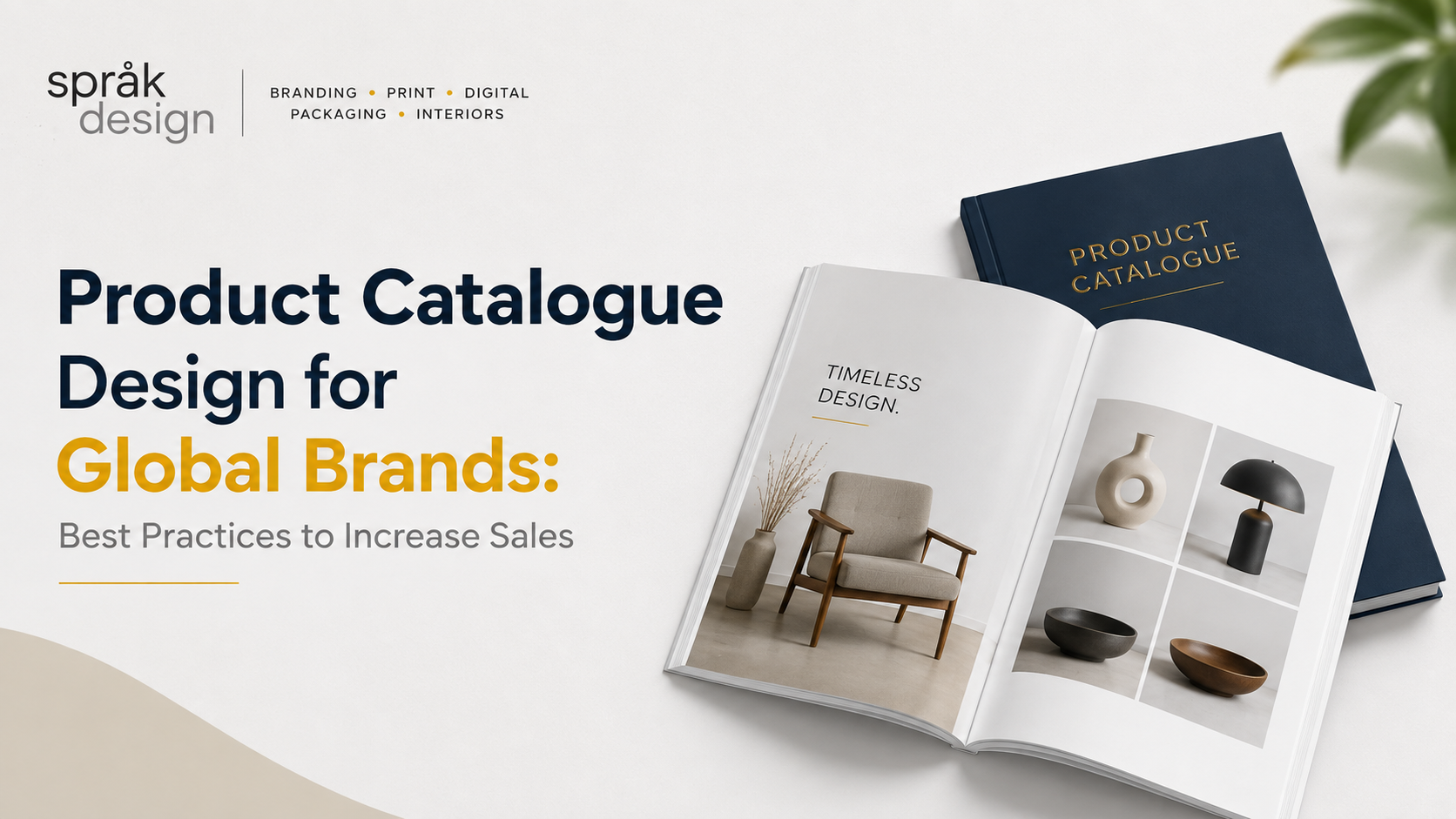
Product Catalogue Design for Global Brands


Picture this: a potential buyer in Chicago and a wholesale distributor in Mumbai open your product catalogue within minutes of each other. One is scanning on a laptop during a coffee break, the other is flipping through a printed copy at a trade show. If your catalogue doesn’t speak clearly to both of them — instantly — you’ve likely lost the sale before it even started.
That’s the real challenge behind product catalogue design today. It’s no longer just about listing products with prices. It’s about building a visual, structured, and strategic document that guides a buyer from curiosity to conversion, regardless of where they are or how they’re viewing it.
For global brands operating across the US, India, and beyond, catalogue design has become a quiet but powerful growth lever. A well-designed catalogue builds trust, shortens sales cycles, and reflects brand credibility — while a cluttered or outdated one does the opposite. In this guide, we’ll break down everything you need to know about designing a catalogue that works as hard as your sales team does, drawing on how agencies like Sprak Design approach catalogue projects for global clients.
Quick stats worth knowing before you start:
- B2B buyers review ~11 pieces of content before contacting a vendor
- 60–70% of the buying journey now happens without a salesperson involved
- The global catalogue market is estimated between $108B–$177B in 2025–2026, growing fast
- Print catalogues still outperform digital ads on brand recall — but digital wins on speed, cost, and reach
What Is Product Catalogue Design?
Product catalogue design is the process of organizing, visualizing, and presenting a brand’s products in a structured document — print or digital — that helps buyers understand what’s on offer and why it matters to them.
It sits at the intersection of three disciplines:
- Marketing — telling a compelling brand and product story
- Design — creating visual hierarchy, consistency, and readability
- Sales enablement — making it easy for a buyer to say yes
A catalogue isn’t a brochure, and it isn’t a price list. It’s a hybrid document that needs to inform, persuade, and simplify decision-making at the same time.
Why Catalogue Design Matters More Than Ever in 2026
Buyers today — whether B2B procurement managers or B2C shoppers — have shorter attention spans and higher expectations for visual clarity. The numbers back this up, and they explain exactly why catalogue design still matters so much for businesses in 2026:
- B2B buyers are self-educating before they ever talk to sales. On average, buyers now review around 11 pieces of content — catalogues, spec sheets, case studies — before they’re ready to contact a vendor, and roughly 60–70% of the purchasing journey is completed independently, without sales involvement.
- AI is now part of the research stack. A large majority of B2B buyers use tools like ChatGPT, Gemini, or Google’s AI Overviews as a starting point for vendor research, then validate what they find through peer reviews and product documentation — which means your catalogue’s content needs to be structured and specific enough to hold up under that scrutiny.
- Poor product information kills conversions. Roughly half of shoppers abandon product pages or listings that lack accurate information or clear visuals — a pattern that applies just as much to a poorly designed catalogue page as it does to a website.
- Deals stall without clarity. Industry research shows a majority of B2B purchases stall somewhere in the buying process, and buyer dissatisfaction with vendors is often tied to confusing or inconsistent information rather than the product itself.
- The catalogue market itself is expanding fast. Independent market research firms currently value the global catalogue market anywhere from roughly $108 billion to $177 billion depending on scope, with consistent double-digit growth forecasts through 2030 — driven largely by digital-first and AI-assisted buying behavior.
There’s a real business case behind this too — see why catalogue design delivers measurable value for growing businesses beyond just aesthetics.
In short, your catalogue is often the first real “product experience” a buyer has with your brand — and increasingly, it’s being evaluated by both humans and AI tools before a single conversation happens.
Core Principles of Effective Product Catalogue Layout
A strong product catalogue layout isn’t about cramming in more products — it’s about making the right products easy to find and easy to understand. Here are the foundational principles that separate catalogues that convert from ones that get ignored.
1. Visual Hierarchy First
Every page should guide the eye naturally — from hero product, to supporting details, to call-to-action. Use size, color, and whitespace deliberately rather than decoratively.
2. Consistent Grid Systems
A repeatable grid (e.g., 2-column, 3-column, or modular blocks) keeps the catalogue visually predictable, which actually builds trust. Buyers subconsciously associate consistency with reliability.
3. Category-Based Navigation
Long catalogues need a clear index, section dividers, and tabbed navigation (physical or digital) so buyers can jump straight to what they need instead of scrolling endlessly.
4. High-Quality, Standardized Photography
Mismatched lighting, angles, or backgrounds across product images is one of the fastest ways to look unprofessional. Standardize your shoot specifications before design even begins.
5. Scannable Product Information
Buyers rarely read every word. Use:
- Bold product names and SKUs
- Short benefit-driven descriptions (not just specs)
- Bullet-pointed technical details
- Clear pricing or “request a quote” prompts
6. Mobile and Digital Responsiveness
If your catalogue will be viewed as a PDF or embedded on your website, it needs to remain legible when zoomed on a phone screen — not just on a 24-inch monitor.
Step-by-Step Process to Design a Product Catalogue
Whether you’re building your first catalogue or redesigning an outdated one, following a structured process prevents costly revisions later.
Step 1: Define Your Audience and Purpose
Ask upfront: Is this catalogue for direct consumers, wholesale buyers, distributors, or internal sales teams? A catalogue for a luxury real estate buyer looks nothing like one for an industrial parts distributor — and it shouldn’t.
Step 2: Audit and Organize Your Product Data
Before any design work begins, consolidate accurate product names, SKUs, specifications, pricing, and imagery into a single source of truth — usually a spreadsheet or PIM (Product Information Management) system.
Step 3: Choose the Right Format
- Print catalogue — ideal for trade shows, luxury positioning, and markets with lower digital penetration
- Digital PDF — cost-effective, easily updated, shareable via email
- Interactive flipbook / web catalogue — best for engagement tracking and SEO value when hosted on your site
Step 4: Build a Wireframe Before Designing
Sketch the page structure — cover, index, category dividers, product grids, back cover with contact details — before applying branding. This avoids expensive redesigns later.
Step 5: Apply Branding Consistently
Typography, color palette, and imagery style should mirror your website and other marketing collateral. A catalogue that feels disconnected from your brand identity undermines trust.
Step 6: Design Product Pages with Purpose
Each product page should answer three buyer questions almost instantly:
- What is this?
- Why does it matter to me?
- What do I do next?
Step 7: Proofread and Localize
For global brands, this step is critical — pricing currencies, measurement units (metric vs. imperial), and even color symbolism can vary significantly between US and Indian audiences.
Step 8: Test Before Mass Production
Send digital proofs to a small internal group or sample customers. Catch layout issues before committing to bulk printing or a full website launch.
Product Catalogue Ideas That Actually Convert
If you’re short on inspiration, here are proven product catalogue ideas worth considering, depending on your industry and goals:
- Storytelling catalogues — Open with a brand narrative before diving into products, ideal for lifestyle, fashion, or home décor brands.
- Comparison-style layouts — Side-by-side specification tables, useful for technical or industrial products like DEF/AdBlue solutions or solar equipment.
- Lookbook-style catalogues — Heavy on lifestyle imagery, lighter on text, common in fashion and luxury real estate marketing.
- Modular digital catalogues — Built so individual product pages can be updated or swapped without redesigning the entire document.
- Seasonal or limited-edition catalogues — Shorter, timely catalogues built around a launch, festival, or campaign (highly effective for FMCG and retail brands).
- QR-code-enabled print catalogues — Bridge print and digital by linking physical pages to live product pages, videos, or updated pricing.
Product Catalogue Examples Worth Learning From
Looking at real-world product catalogue examples helps clarify what “good” actually looks like in practice:
- IKEA’s catalogue remains a benchmark for balancing lifestyle imagery with practical product information at scale.
- Apple’s product pages (functionally a digital catalogue) show how minimal text and strong visual hierarchy can still convey deep technical detail.
- B2B industrial catalogues, such as those used by manufacturing and EPC companies, demonstrate how comparison tables and technical specification blocks build buyer confidence without overwhelming the page.
- Fashion lookbooks from global apparel brands show how photography-led layouts with minimal copy can still drive strong purchase intent.
The common thread across all strong examples: clarity beats clutter, every single time.
Print vs. Digital Catalogue Design: What the Current Data Shows
Here’s the honest, data-backed picture for 2026: print is not dying, and digital is not “winning” outright — the two are splitting into different jobs. Global brands are managing both at once, and the right split depends on what a catalogue needs to do.
What the data actually shows:
- Print marketing continues to hold a meaningfully higher recall rate than digital advertising, and direct mail (including printed catalogues) sees response rates that regularly outperform email marketing.
- At the same time, the global catalogue market itself is shifting decisively toward digital — most current market research places the overall catalogue industry between roughly $108 billion and $177 billion in 2025–2026, with digital formats posting the fastest growth and North America and Asia-Pacific as the two leading regions.
- Digital catalogues remain the clear winner for update speed, distribution cost across countries, and measurability — factors that matter enormously for brands running the same catalogue across US and Indian markets simultaneously.
- A growing “phygital” trend — QR codes on printed catalogue pages linking to live digital product data — is now one of the most common ways brands bridge the trust of print with the flexibility of digital.
| Factor | Print Catalogue | Digital Catalogue |
|---|---|---|
| Recall & trust | Higher — tactile format builds stronger brand recall | Lower on its own, but supports retargeting |
| Cost to update | High (reprinting required) | Low (instant edits, no reprint cost) |
| Best use case | Trade shows, luxury positioning, direct mail | E-commerce, email campaigns, sales enablement |
| Shelf life | Fixed until next reprint | Continuously updatable |
| Trackability | Limited to none | High — views, clicks, downloads, time on page |
| SEO value | None | Can drive organic traffic if web-hosted correctly |
| Regional distribution (US + India) | Costly and slow across countries | Instant and effectively borderless |
For most global brands in 2026, the practical approach is a digital-first catalogue — built once as a modular design system — with a print-ready version generated from the same files for trade shows, direct mail, or markets where physical catalogues still carry more weight. Building each format from scratch separately is where most of the wasted design budget happens.
Common Product Catalogue Design Mistakes to Avoid
Even experienced marketing teams fall into predictable traps. Watch out for:
- Inconsistent product photography — different lighting, backgrounds, or resolutions across pages
- Overcrowded pages — trying to fit too many products per spread, sacrificing readability
- Outdated pricing or specifications — especially damaging for B2B catalogues used by procurement teams
- No clear call-to-action — missing “Contact us,” “Request a quote,” or “Shop now” prompts
- Ignoring accessibility — poor color contrast or tiny fonts that fail on both print and screen
- One-size-fits-all approach — using the exact same catalogue for vastly different markets without localization
Catalogue Design Services: When to Bring in Experts
Not every brand has in-house design bandwidth to manage catalogue creation alongside everything else. This is where professional catalogue design services typically add the most value:
- Large product ranges (100+ SKUs) that need systemized, template-driven layouts
- Multi-market brands requiring localization across currencies, languages, and units
- Rebranding initiatives where the catalogue needs to reflect a new visual identity
- Time-sensitive launches where internal teams are stretched thin
A good catalogue design partner brings not just aesthetic skill, but also structured content strategy, print production knowledge, and an understanding of how catalogues fit into the broader sales funnel — from SEO-optimized digital versions to print-ready files for global distribution. If you’re evaluating whether to outsource this, it’s worth starting a conversation to scope out what your product range and markets actually need.
How Product Catalogue Design Impacts SEO and Digital Visibility
If your catalogue lives online — as a downloadable PDF or an embedded web catalogue — it can do more than sell. It can also support organic visibility when designed with SEO in mind:
- Use descriptive, keyword-rich file names (e.g., product-catalogue-2026.pdf rather than catalogue-final-v3.pdf)
- Add alt text to product images if the catalogue is embedded on a web page
- Include a text-based product index on the hosting page, since PDFs alone are harder for search engines to fully index
- Link internally from relevant blog posts or category pages to the catalogue
This turns a traditionally static sales document into a genuine digital asset that continues working long after it’s published.
Conclusion: Turning Your Catalogue Into a Growth Asset
Thoughtful product catalogue design isn’t a nice-to-have anymore — it’s a direct reflection of how seriously buyers perceive your brand. From layout and photography to format choices and localization, every decision either builds confidence or creates friction in the buyer’s journey.
Whether you’re refreshing an existing catalogue or building one from scratch for a global audience, the goal remains the same: make it effortless for buyers to understand your products and take the next step. If your current catalogue feels outdated, cluttered, or disconnected from your brand, it may be time to explore professional catalogue design services that can bring structure, consistency, and strategic thinking to the process. Get in touch with our team to discuss your catalogue project.
Author

Frequently Asked Questions
There’s no universal size, but A4 (210x297mm) is common for print catalogues in most global markets, while digital catalogues are often designed at 8.5×11 inches or optimized for widescreen viewing on web and tablet.
This depends on the product type. Simple, similar items can work well in grids of 4–6 per page, while complex or technical products often need a full page each for adequate detail.
Digital catalogues should be reviewed quarterly or whenever pricing, specifications, or the product line changes. Print catalogues are typically refreshed annually or seasonally, depending on the industry.
Adobe InDesign remains the industry standard for professional catalogue layouts, often paired with Photoshop for image editing and tools like Canva for simpler, template-based catalogues.
This depends on your business model. B2C and retail catalogues often include pricing for transparency, while B2B and industrial catalogues frequently use “Request a Quote” prompts due to variable pricing based on volume or region.
A brochure typically promotes a single product, service, or campaign, while a catalogue is a comprehensive, structured listing of a brand’s full or partial product range.