


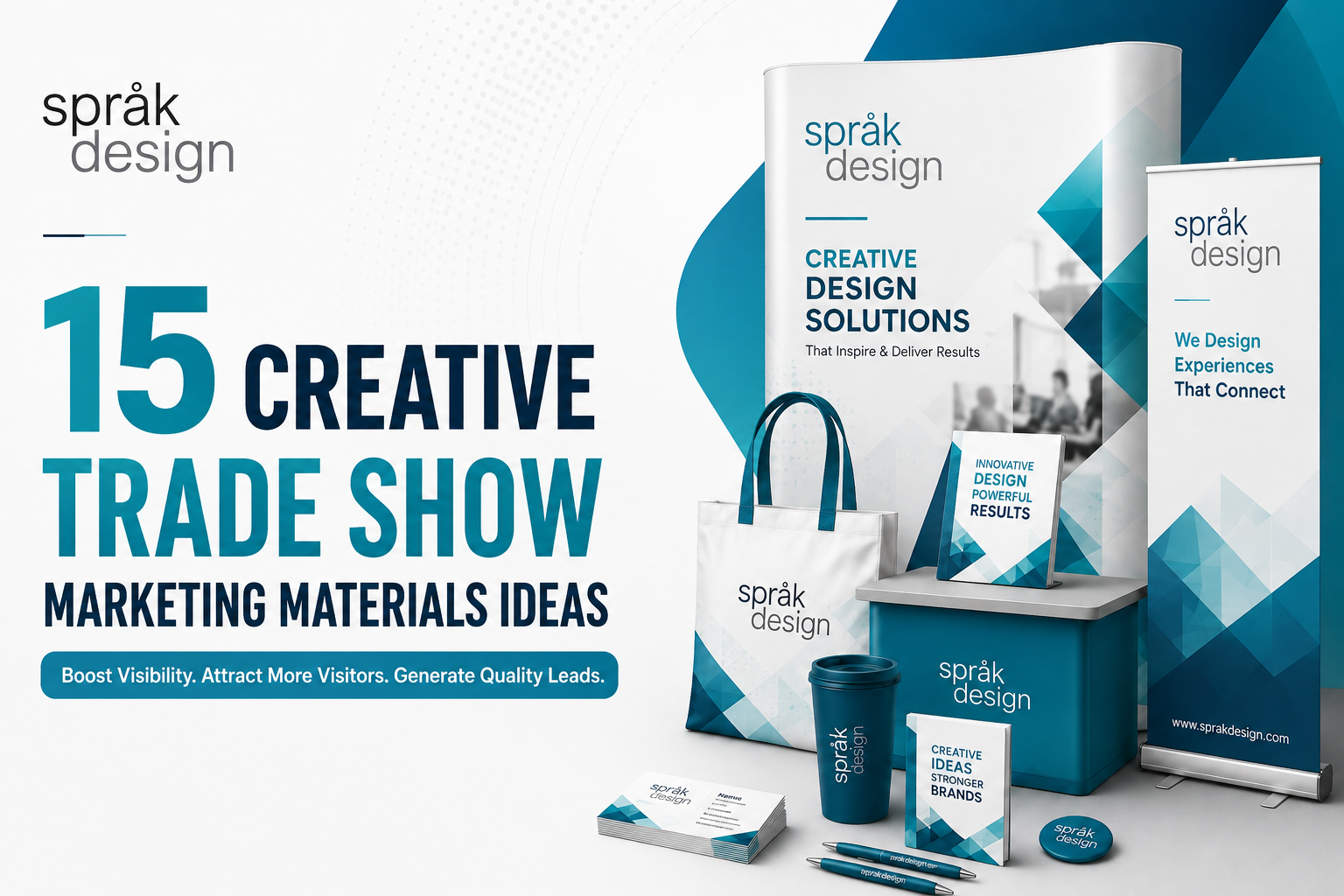
15 Creative Trade Show Marketing Materials Ideas


Trade shows remain one of the most effective channels for B2B and B2C lead generation, but a booth is only as strong as the marketing materials supporting it. The right trade show marketing materials do more than decorate a space — they capture attention in a crowded hall, communicate your value proposition in seconds, and give visitors a reason to stop, engage, and share their contact details.
Many exhibitors still rely on generic banners, stacks of brochures, and business cards that get lost in a visitor’s bag by the end of the day. This approach rarely converts. To stand out, exhibitors need a mix of visual, interactive, and printed materials designed around how attendees actually move through an event — quickly, visually, and with limited attention spans.
This guide walks through 15 creative trade show marketing materials ideas, covering everything from booth signage and trade show brochure design to digital tools and lead-capture systems. Whether you’re planning your first exhibition or refining a strategy that’s grown stale, these ideas are built to increase foot traffic, strengthen brand recall, and generate more qualified leads.
Why Trade Show Marketing Materials Matter for Lead Generation
Trade show marketing materials directly influence whether a visitor stops at your booth, remembers your brand, and follows up after the event. Well-designed materials reduce the cognitive effort required for attendees to understand what you offer, which increases both booth engagement and post-show conversion rates.
At a typical trade show, attendees walk past dozens of booths in a single hour. Decisions about which booths to visit are made in seconds, based almost entirely on visual cues — signage, lighting, color, and movement. Materials that communicate your offer clearly and quickly have a measurable advantage over those that rely on staff to explain everything verbally. Independent research from the Center for Exhibition Industry Research (CEIR) has consistently found that visual presentation and booth staff engagement are among the top factors influencing whether an attendee stops at a booth.
Beyond attracting visitors, the right materials also support the lead-generation process itself. A well-designed trade show brochure or leave-behind gives prospects something tangible to review after the event, when the buying decision is often actually made. Materials that include clear calls-to-action, QR codes, or follow-up incentives extend the conversation beyond the show floor.
Key takeaway: Trade show marketing materials should be evaluated on two criteria — their ability to attract attention on the floor, and their ability to support follow-up after the event ends.
15 Creative Trade Show Marketing Materials Ideas
1. Modular Backlit Displays
Backlit signage creates a visual glow that stands out under standard convention hall lighting, making it far more noticeable than flat, unlit banners. Modular backlit displays use LED panels behind fabric or acrylic graphics, allowing exhibitors to reconfigure the layout for different booth sizes across multiple events.
These displays work particularly well as a backdrop for the main booth wall, where they can showcase the brand name, tagline, and core value proposition from a distance.
- Best for: Brand visibility from across the hall
- Consideration: Higher upfront cost, but reusable across multiple shows
2. Interactive Touchscreen Kiosks
Touchscreen kiosks let visitors explore product catalogs, watch demo videos, or complete quote requests without waiting for staff availability. This is especially useful during peak hours when booth staff are occupied with other conversations.
Interactive kiosks also double as a subtle lead-capture tool — many kiosk software platforms allow visitors to enter their email to receive a summary of what they viewed, creating a natural data-capture moment.
3. Branded Trade Show Brochure Design
A well-designed trade show brochure remains one of the most versatile trade show marketing materials because it works both on the floor and after the event. Effective trade show brochure design prioritizes scannability — bold headers, short sections, and visual hierarchy — over dense blocks of text, since most attendees only skim printed materials during the show itself.
For industries like art exhibitions or luxury services, an art exhibition brochure often incorporates high-quality photography and minimal text, letting the visuals carry the value proposition. For technical or B2B industries, brochures typically include specification tables, use cases, and contact details for follow-up.
- Best for: Leave-behind material that supports post-show decision-making
- Consideration: Keep content date-agnostic where possible, so brochures remain usable across multiple shows
4. QR Code-Enabled Signage
QR codes bridge printed materials with digital experiences, letting visitors instantly access product demos, pricing sheets, or registration forms from their phones. Placing QR codes on banners, brochures, and business event brochure materials reduces the need for visitors to carry printed paperwork while still capturing engagement data.
Because most attendees already default to scanning codes for quick information, this has become a standard expectation rather than a novelty — but the destination page matters more than the code itself. Link QR codes to mobile-optimized landing pages, not generic homepages.
5. Custom Branded Tablecloths and Table Runners
Table coverings are often overlooked, but they occupy a large, eye-level visual surface at eye level for many visitors. Custom-branded tablecloths reinforce brand colors and logos consistently across the booth, tying together signage, brochures, and giveaways into a cohesive visual identity.
6. Digital Lead Retrieval Systems
Digital lead retrieval tools — badge scanners or app-based capture systems — replace manual business card collection with structured, exportable data. These systems typically allow staff to tag leads by interest level or product category on the spot, making post-show follow-up significantly faster and more targeted.
This is one of the most important trade show booth supplies for measuring event ROI, since it directly ties booth visits to a trackable database of prospects.
7. Pop-Up Retractable Banners
Retractable banners remain a staple among trade show booth supplies because they’re lightweight, quick to set up, and inexpensive to reproduce for multiple events. They work best positioned at booth entry points or aisle-facing corners, where they can catch the attention of attendees walking past without stopping.
- Best for: Budget-conscious exhibitors needing fast setup
- Consideration: Limit to one core message per banner — overcrowded banners lose visual impact
8. Branded Promotional Giveaways Tied to Booth Activities
Generic pens and tote bags rarely drive meaningful engagement anymore. More effective giveaways are tied to an activity — a spin-the-wheel game, a quiz, or a product demo — so the item becomes a reward for engagement rather than a passive handout. This structure naturally creates a lead-capture opportunity, since participation typically requires contact details.
9. Product Demo Stations with Live Sampling
For physical products, a live demo station allows attendees to interact with the product directly rather than reading about it on a brochure. This is particularly effective for industries where the value proposition is difficult to communicate through text alone, such as manufacturing, industrial equipment, or consumer goods.
Demo stations also naturally draw crowds, since attendees are more likely to stop when they see other visitors already engaged.
10. Branded Business Event Brochure with Segmented Content
Rather than a single generic brochure, some exhibitors create a business event brochure segmented by audience type — for example, separate one-pagers for distributors, end customers, and investors. This allows booth staff to hand visitors only the content relevant to their role, improving both relevance and perceived professionalism. Getting this segmentation right on the page is largely a design and messaging exercise, which is why many exhibitors bring in a specialist brochure design company rather than adapting an existing single-audience brochure.
11. Large-Format Hanging Signage
For booths with ceiling access, hanging signage extends brand visibility above the crowd, making the booth identifiable from across the hall even when floor-level sightlines are blocked by other displays. This is especially valuable at larger trade shows where booths are spread across a wide floor plan.
12. Branded Charging Stations
Charging stations address a genuine attendee need — low phone battery — while keeping visitors at the booth for several minutes at a time. This extended dwell time creates more opportunities for staff to start conversations without a hard sales pitch.
13. Printed Case Study or Testimonial Cards
Short, visually structured case study cards provide social proof without requiring visitors to read a full brochure. These work well as a secondary leave-behind alongside the primary trade show brochure, particularly for B2B exhibitors where credibility and past results influence purchase decisions.
14. Augmented Reality (AR) Product Previews
AR previews, accessed via a QR code or booth tablet, let visitors visualize a product in a real-world context — useful for industries like real estate, interior design, or large equipment where physical demonstration isn’t practical at a booth. This is a higher-investment idea but creates a memorable, shareable experience that can extend brand reach through word-of-mouth and social sharing.
15. Branded Follow-Up Email Kits Prepared in Advance
While not a physical booth material, pre-built follow-up email templates tied to specific lead categories (hot lead, general inquiry, partnership interest) ensure that momentum from the show doesn’t stall during the days after the event. Pairing this with the digital lead retrieval system (Idea 6) allows staff to trigger the right email sequence within hours of a booth conversation, when recall is still fresh.
How to Choose the Right Trade Show Marketing Materials for Your Booth
Choosing the right combination of trade show marketing materials depends on your budget, booth size, industry, and the type of leads you’re trying to generate. A useful starting point is to separate materials into three categories: attention-grabbing (signage, lighting, AR), engagement-driving (kiosks, demos, giveaways), and follow-up-supporting (brochures, case study cards, lead retrieval). Whatever the mix, every material should trace back to a single, consistent brand identity — which is why this planning stage is often easier with an established brand creation company already guiding the visual system.
| Material Type | Primary Purpose | Typical Cost Level |
|---|---|---|
| Backlit displays | Attract attention from a distance | High (reusable) |
| Retractable banners | Budget-friendly visibility | Low |
| Interactive kiosks | Engage visitors without staff | High |
| Trade show brochures | Support post-show follow-up | Low to Medium |
| Digital lead retrieval | Capture and organize leads | Medium |
| Branded giveaways | Drive activity-based engagement | Low to Medium |
| AR previews | Create memorable, shareable experiences | High |
A balanced booth typically includes at least one material from each category rather than over-investing in a single type. For example, a striking backlit display attracts visitors, but without a lead retrieval system or brochure to support follow-up, the booth traffic generated may not convert into measurable pipeline.
Factors to Consider Before Finalizing Materials
- Booth size and layout: Large-format signage and hanging displays require adequate ceiling or wall space; smaller booths benefit more from compact, high-impact items like retractable banners and tabletop kiosks.
- Reusability across events: Materials without event-specific dates or locations printed on them can be reused across multiple shows, reducing long-term cost.
- Staying current: Print and layout preferences shift over time — reviewing current brochure design trends before finalizing materials helps avoid a booth that looks visually dated next to competitors.
- Industry expectations: A luxury or creative industry booth — such as one using an art exhibition brochure — often prioritizes visual and print quality over interactive technology, while technical or industrial exhibitors benefit more from live demos and data sheets.
- Staff capacity: Interactive materials like kiosks and demo stations reduce staff workload, which matters at high-traffic booths where staff can’t engage every visitor personally.
- Lead-tracking requirements: If measuring ROI is a priority, digital lead retrieval should be treated as a core material, not an optional add-on.
Common Mistakes Businesses Make with Trade Show Materials
Businesses commonly encounter a few recurring issues when planning trade show materials, most of which are avoidable with earlier planning:
- Overloading brochures with text: Dense brochures are rarely read on the show floor; visitors skim for headlines and visuals first.
- Treating giveaways as a standalone tactic: Items given away without a connected engagement activity rarely generate qualified leads.
- Underestimating lighting and visibility: A booth with strong materials but poor lighting can still be overlooked in a crowded hall.
- Skipping post-show follow-up planning: Materials that generate leads are only valuable if a follow-up process is ready to act on them quickly.
- Using one-size-fits-all messaging: Segmenting materials by audience type, as with a business event brochure, typically performs better than a single generic handout.
Key Takeaways
- Trade show marketing materials should be selected based on both floor-level attraction and post-show follow-up support.
- A mix of visual (signage, lighting), interactive (kiosks, AR, demos), and printed (brochures, case study cards) materials generally outperforms relying on a single material type.
- Digital lead retrieval systems are increasingly essential trade show booth supplies for measuring event ROI.
- Trade show brochure design should prioritize scannability and visual hierarchy over dense text.
- Industry and audience type should guide material selection — a luxury or creative exhibitor’s needs differ significantly from a technical B2B exhibitor’s.
Conclusion
Creative trade show marketing materials — from backlit displays and interactive kiosks to well-designed brochures and digital lead retrieval systems — play a direct role in how many visitors a booth attracts and how many of those visitors convert into qualified leads. The strongest exhibitors treat materials as an integrated system: attention-grabbing visuals to draw visitors in, engaging tools to hold their interest, and follow-up-ready materials to keep the conversation going after the show ends.
If you’re planning an upcoming trade show and want to build a materials strategy tailored to your industry, budget, and lead-generation goals, consider auditing your current booth setup against the 15 ideas above to identify the highest-impact gaps — or get in touch to discuss your next event.
Author

Frequently Asked Questions
For smaller booths, retractable banners, a well-designed trade show brochure, and a digital lead retrieval tool typically deliver the strongest return, since they require minimal space and setup while still supporting both visibility and follow-up.
Budgets vary widely based on booth size and material choices, ranging from a few hundred dollars for basic printed materials to several thousand for custom displays, kiosks, or AR experiences. A balanced approach typically allocates spend across attention-grabbing, engagement, and follow-up materials rather than concentrating budget in one category.
An effective trade show brochure design uses clear visual hierarchy, minimal text blocks, and strong headline messaging so visitors can absorb the core offer within seconds, with more detailed information available for later reading.
Yes — printed materials remain relevant as tangible leave-behinds that visitors physically carry away, while digital tools like QR codes and kiosks are typically used to extend or support that printed content rather than replace it entirely.
ROI is typically measured by connecting lead volume and quality, captured through digital lead retrieval systems, to eventual conversion rates and revenue attributed to those leads, rather than by measuring booth traffic alone.
Yes — for example, a luxury real estate or art exhibition brochure typically emphasizes high-quality visuals and minimal text, while a technical or industrial exhibitor’s materials often include specification details, live demonstrations, and data-driven content.
The most common mistake is prioritizing visual materials without an equally strong plan for lead capture and post-show follow-up, resulting in booth traffic that doesn’t convert into measurable business outcomes.